What’s Nonetheless Feeding Pollinators in Your Fall Backyard?
by Silvia Strobl, Grasp Gardener
It has been a heat begin to the autumn season, however regardless of somewhat extra frequent rain in September, the summer time drought has continued right here north of Peterborough in my 4b Plant Hardiness Zone backyard. My soil can be sandy and dry. So what might nonetheless be blooming and feeding our simplest pollinators, the native bumble bees?
Though bumble bees are extra energetic in spring and summer time, they nonetheless want nectar and pollen in fall as a result of the gynes, unmated females that may turn out to be subsequent yr’s new queen bees if fertilized, are mating after which should construct up fats reserves and discover a place to overwinter (The Xerces Society 2025). At the moment of yr you might even see bumble bees sleeping on flowers within the morning, particularly after a chilly night time or in a single day rainfall. These are largely the solitary male bumble bees that sleep outside. They’re looking for a mate, after which they may die. Dangerous climate may power feminine bumble bees to sleep outside, however their desire is to return to the hive at night time (St. John 2023).
Listed below are a number of drought-hardy native species that had been nonetheless blooming and supporting pollinators in my backyard on October tenth. All are proof against deer. Solar, soil and moisture necessities, peak, bloom color and bloom time are famous for every.
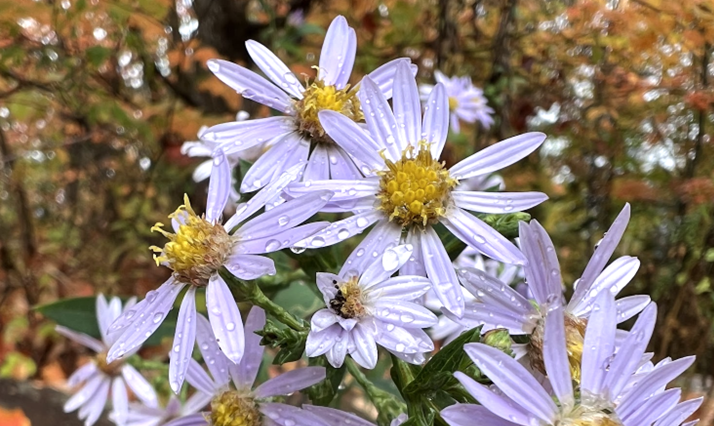
Easy Aster (Symphyotrichum laeve)
Full solar – gentle shade; Sand, loam, clay; Dry to Medium; 4 toes tall; Lavender to gentle blue; September – October
Easy Aster has very frost-hardy flowers that usually bloom into early November. The lavender to gentle blue flowers present a lavish show. It has an upright type, is salt tolerant, and has the flexibility to outlive drought.

New England Aster (Symphyotrichum novae-angliae)
Full solar – Half solar; Sand, loam, clay; Moist-average soil; Tolerates dry soil however could look scraggly; 2-5 toes tall; Purple, pink; August – October
New England Aster is one other late bloomer, usually lasting till it’s hit by a number of onerous frosts (Sales space nd). It’s a clumping perennial that may be divided each 3-5 years and in addition “politely” seeds into backyard gaps. To maintain it from flopping over in fertile soils, it may be “Chelsea-chopped” in mid-June to limit its peak. It is a crucial nectar plant for migrating Monarch butterflies, in addition to a larval host for five butterflies and greater than 40 moth species (Sales space and Grey 2024).

Zig Zag Goldenrod (Solidago flexicaulis)
Half shade to Full Shade; Prefers, fertile loam however tolerates heavy clay; Effectively-drained soils; 1-3 toes tall; Yellow; August – October
Zig Zag Goldenrod is a non-aggressive goldenrod that may be a welcome boost to the shade backyard. It offers pollen and nectar for each short- and long-tongued bees, wasps, flies and butterflies and it’s the larval host plant for over 45 species of moths (Sales space and Grey 2024).

Blue-stemmed Goldenrod (Solidago caesia)
Half shade to Full Solar; Most well-drained soils, tolerates poor soil; 1.5 – 3 toes tall; Yellow; August – October
Blue-stemmed goldenrod has yellow clusters of flowers that bloom all alongside the purplish-blue stem in early autumn, creating streaks of gold if planted in massive patches. In contrast to different goldenrods, it doesn’t unfold aggressively. Its leaves host larvae of 45 moth species (Grey and Sales space 2024).

Button Blazing Star (Liatris aspera)
Full Solar; Dry-Medium; Sand, loam; 2 – 5 toes tall; Yellow; August – October; Purple-Pink
Button Blazing Star is among the most drought tolerant blazing stars. In contrast to Dense Blazing Star (Liatris spicata) its flowers are held on particular person stems slightly than in spikes and the corms can’t be divided. Birds particularly favor its seeds (Diboll and Cox 2023).

The night of October ninth we had a second onerous frost (-6oC with wind chill) however the subsequent day all of those native perennials had been nonetheless blooming. In case you are your backyard this Thanksgiving and never seeing any vegetation nonetheless flowering and supporting pollinators, possibly make plans so as to add one or two of those subsequent spring?
REFERENCES
Sales space, S. no date. Native Asters for Ontario Gardens.
Diboll, N. & H. Cox. 2023. The Gardener’s Information to Prairie Crops. The College of Chicago Press. 636 pp.
Grey, R. and S. Sales space. 2024. The Gardener’s Information to Native Crops of the Southern Nice Lakes Area. Firefly Books. 352 pp.
St. John, Okay. 2023. A Nearer Have a look at Sleeping Bumblebees. Exterior my Window weblog submit.
The Xerces Society. 2025. Bumble Bees: Nesting and Overwintering.
RELATED