Spider Mites on Your Houseplants

Spider mites are some of the frequent and irritating pests an indoor gardener can encounter. They are often laborious to manage if you happen to don’t perceive the pest and use the proper methods to manage it.
Sadly, a whole lot of the knowledge on-line is unsuitable, which causes pointless frustration and misplaced crops.
Key Takeaways
- Spider mites favor heat, dry locations, like your property in winter.
- Verify crops often and quarantine new crops.
- Management with insecticidal cleaning soap or horticultural oil.
Perceive Spider Mites
You possibly can’t management a pest you don’t perceive. Nor are you able to consider on-line options from fellow gardeners. So let’s begin by understanding the pest.
Spider mites are tiny, plant-attacking organisms that aren’t really bugs; they’re arachnids, putting them within the similar household as spiders, scorpions, and ticks. They’re present in nearly any habitat, together with the house backyard. In case you have houseplants, particularly these struggling throughout winter, you might want to know spot and cease these microscopic vampires earlier than they overwhelm your assortment.
The time period “spider mite” is usually used broadly for species that assault crops. Whereas the knowledge right here pertains primarily to the two-spotted spider mite (Tetranychus urticae), which is a very powerful and customary species on houseplants, you will need to notice that many various kinds of webspinning mites exist. Different carefully associated species within the Tetranychus genus, such because the Pacific spider mite or the strawberry spider mite, may also be discovered, although their injury patterns, biology, and administration are nearly the identical.
Infestations are inclined to peak when circumstances are scorching and dry. Because of this the dry, low-humidity air generally discovered inside houses, particularly throughout winter heating cycles, gives the right setting for mites to thrive. Management is best when these pests are caught early. Our major protection entails vigilant monitoring, making cultural changes (like managing humidity), and utilizing efficient contact remedies.
Figuring out the Risk: What Do Spider Mites Look Like?
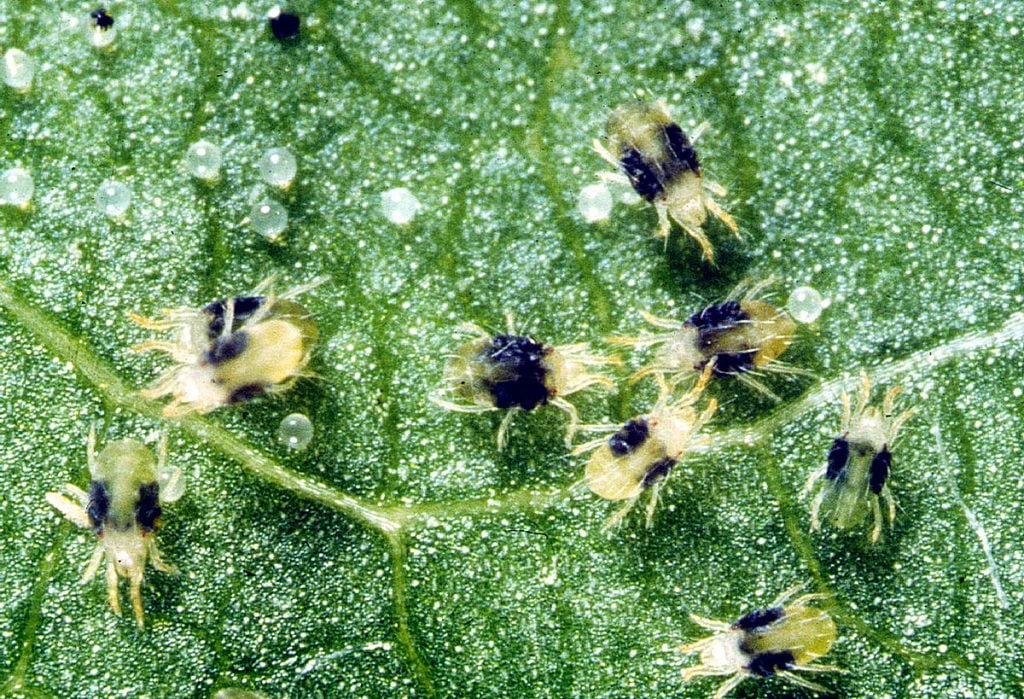
Spider mites are notoriously troublesome to see as a result of they’re so small. To the bare eye, they appear to be nothing greater than tiny, shifting dots. Grownup females are the most important kind, measuring lower than 1/20 inch lengthy—roughly the scale of a interval drawn with a pencil or a grain of sand.

As arachnids, grownup spider mites sometimes have eight legs and an oval physique. Once they first hatch, the larvae have solely six legs, progressing by way of two nymphal levels earlier than reaching maturity. The 2-spotted spider mite is normally pale inexperienced to orange in the course of the rising season and sometimes has two darkish spots on its physique. Later generations, or these getting ready to overwinter, might seem pink or orange, which is why some folks confer with them as “pink spiders”. Their eggs are spherical and translucent, showing like tiny droplets, and are typically too small to see with out magnification.
Mites aren’t randomly distributed; they dwell in dense colonies. They feed and reside predominantly on the undersides of leaves.
A vital level for management is recognizing the place they don’t dwell: spider mites don’t dwell in or feed on the soil or roots. They want chlorophyll-containing plant tissue to outlive.
Fable: The frequent suggestion to exchange all of the soil and wash the roots is mindless since they don’t dwell in soil or eat plant roots.
To scout for mites, common and frequent inspection is critical. You should use a 10X hand lens to carefully examine the undersides of discolored leaves. A fast detection technique is to carry a white piece of paper beneath a probably infested leaf, then gently shake the leaf. If mites are current, they are going to fall onto the paper and, as soon as disturbed, will transfer round quickly, making the dots simple to see.
Recognizing Harm and Infestation Indicators
Spider mites trigger injury through the use of piercing-sucking mouthparts to take away chlorophyll and suck cell contents from the plant tissue. A small variety of mites is normally not an issue, however excessive populations can severely injury crops.
The injury typically begins within the decrease, older development of the plant and expands upward because the inhabitants grows. The most typical preliminary symptom is stippling. Stippling seems as tiny white or yellow spots the place the inexperienced chlorophyll pigment has been eliminated by the mites’ feeding. If the injury is intensive, the leaves might turn out to be pale, unusually yellow, or look typically unhealthy, much like how a plant seems if it wants fertilizer or is drought-stressed.
As feeding progresses, some plant varieties might reply with bronzing—growing a bronze or brownish forged to the leaves. Closely infested leaves might finally flip yellowish or reddish and drop prematurely. On annual crops, such extreme injury can result in the demise of the plant.
Within the case of extreme infestation, leaves can tackle a dusty, gritty feeling. This tough texture is brought on by the buildup of mite residue, together with shed exoskeletons (skins), fecal matter, and wonderful webbing.
Essentially the most recognizable signal of a big, entrenched colony is webbing. This wonderful silk, which is analogous to, however usually a lot finer than, spider webs, is discovered throughout new development, between leaves, and overlaying the colonies. A buildup of webbing is a definitive indication of a extreme infestation.

Why Spider Mites Thrive Indoors
Spider mites are environmental opportunists, and the circumstances inside most houses are good for his or her exponential development. They’re identified to flourish in scorching, dry climate. Their excellent setting entails temperatures within the 80s (F) and above, coupled with low humidity (lower than 50%). The dry, arid setting of a centrally heated house, particularly in the course of the winter months, usually meets these necessities.
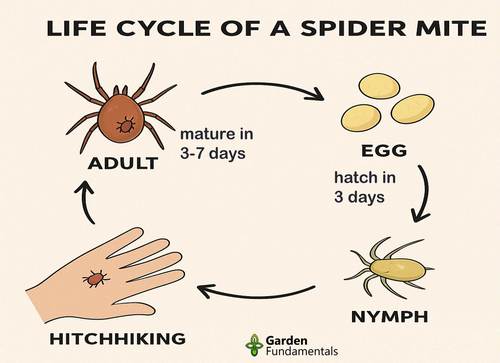
When circumstances are scorching and dry, spider mites reproduce extremely quick. Eggs hatch in 3-5 days, and a brand new era might be accomplished in as little as 5–7 days, resulting in dramatic inhabitants surges that make it appear as if giant numbers appeared in a single day.
Moreover, crops which might be underneath stress are much more inclined to break. Drought-stressed crops are significantly weak, as decreased watering can alter the plant chemistry, making them extra nutritious to mites. Guaranteeing satisfactory watering is subsequently a key a part of prevention.
When spider mites transfer between your houseplants, they primarily unfold by crawling. They crawl from leaf to leaf when crops are touching, or alongside surfaces like windowsills or cabinets. Mites also can drift quick distances on indoor air currents created by followers or HVAC methods, a habits often known as “ballooning,” particularly when populations are excessive.
Nevertheless, the commonest means new infestations begin is by bringing house a brand new plant that already has unseen mites or eggs hidden on the undersides of its leaves. Mites can also hitchhike on fingers or gardening instruments which have brushed in opposition to infested crops.
Controlling Spider Mites
There are two traces of protection: Prevention and Management.
Quick and Cultural Management (The First Line of Protection)
Since spider mites are best to manage when infestations are addressed early, cultural and bodily controls ought to at all times be the primary line of protection.
Isolation and Pruning: If you are going to buy a brand new houseplant, at all times quarantine it for 2 to 3 weeks earlier than putting it close to your primary assortment to forestall introducing pests. For those who uncover mites on an present plant, isolate it instantly. For crops which might be small and closely infested, it’s usually faster and simpler to easily discard them moderately than attempting to revive their well being. For bigger crops, it’s best to pinch off and destroy any closely affected leaves or stems.
Bodily Removing by Water: Mites dislike moisture, and you may leverage this for management. Use a forceful jet of water to bodily dislodge the mites and wash away the webbing they use for defense. You possibly can transfer the plant to a bathe or sink and spray vigorously. It’s vital to make sure thorough protection, particularly focusing on the undersides of the leaves the place the colonies reside. This method is probably not appropriate for very younger or delicate crops.
For bigger leaves, or if spraying is impractical, you should utilize a delicate, damp fabric to wipe off the leaves, paying particular consideration to the undersurfaces.
Humidity Administration: As a result of mites thrive in low humidity (lower than 50%), rising the moisture across the plant may also help scale back its attractiveness to them.
Misting is a typical advice that doesn’t work until you might be prepared to mist each jiffy. Misting also can result in fungal and bacterial illnesses.
Plant Well being and Vigor: Wholesome crops can higher tolerate minor injury from mites. Water stress is a identified issue that contributes to mite injury. Due to this fact, guaranteeing your crops are adequately watered and receiving correct fertilization reduces their general stress and vulnerability to mite assault.
Chemical and Focused Management Strategies
If cultural and bodily controls aren’t sufficient to handle a spider mite inhabitants, focused chemical functions are the following step.
Contact is Essential: The simplest chemical options obtainable to the typical gardener are contact merchandise. This implies the substance should immediately cowl the mites’ our bodies to work successfully. Attaining complete protection, particularly on the densely populated undersides of leaves, is crucial for achievement.
Moreover, most contact merchandise, like cleaning soap and oil, don’t kill the eggs. Due to this fact, repeat functions are required, usually 2–3 days later, to kill the newly hatched mites.
Contact Pesticides (Soaps and Oils)
Insecticidal cleaning soap might be very cheap if you happen to purchase a focus: Cheap Insecticidal Cleaning soap
Utility Cautions: Earlier than utilizing any cleaning soap or oil, check a small space of the plant first to make sure it received’t trigger injury (phytotoxicity). By no means apply soaps or oils if the plant is water-stressed or if the temperature exceeds 80°F to 90°F (26°C to 32°C), as this considerably will increase the chance of leaf burn. At all times water the plant completely earlier than spraying.
Spot Remedy with Alcohol: A standard advice by gardeners is to make use of rubbing alcohol (isopropyl alcohol) for spot therapy or bodily elimination. Though it should work for small infections or for cleansing leaves, it’s not advisable by extension workplaces.
For those who select to spray alcohol, use a extremely diluted answer (e.g., 1–3% focus), as larger concentrations carry a higher danger of leaf burn. At all times check a small space first, and rinse the plant with water after therapy to take away residual alcohol.
Broad-spectrum pesticides
Sure broad-spectrum pesticides, reminiscent of organophosphates or pyrethroids like bifenthrin, additionally work for spider mites. These chemical compounds are sometimes not very efficient in opposition to mites themselves. Use a product that’s labeled for spider mites and comply with directions.
Prevention and Lengthy-Time period Houseplant Well being
Lengthy-term administration depends on steady vigilance and stopping the circumstances that favor mite outbreaks.
The simplest prevention is common scouting for the indicators of mites—stippling and wonderful webbing—particularly when the air is scorching and dry.
To attenuate the chance of unfold, stop crops from touching each other, as crawling is the primary means they transfer indoors. At all times quarantine any new crops for at the very least two to 3 weeks earlier than introducing them to your assortment to make sure they’re pest-free. In case you have dealt with an infested plant, make sure you clear your fingers and instruments earlier than touching wholesome crops to keep away from hitchhiking mites.
Though they’re a irritating and customary pest, spider mites might be efficiently managed within the house setting.