Are Clear Pots Higher for Orchids?

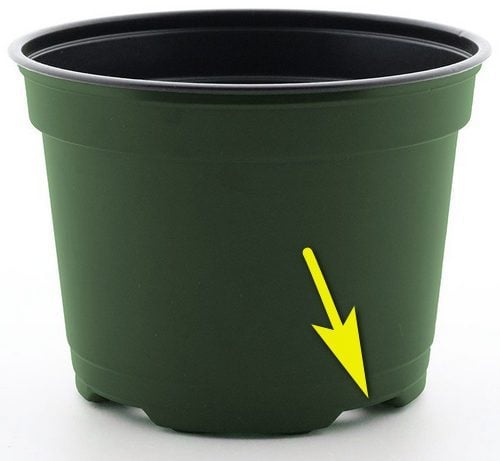
I’ve been rising orchids for over 40 years, and at one level, I grew over 1,000 orchids. At any time when I used to be requested about one of the best orchid pot, I responded with the identical reply. Any inexperienced plastic pot will work simply positive. If it had a raised backside with drainage holes on the backside rim (azalea pot), to permit higher water drainage, that may be higher, however any pot will work.
That reply remains to be appropriate. We all know that as a result of most hobbyists use that sort of pot.
Nonetheless, there may be some new analysis that means a transparent pot could also be higher. Let’s take a look at what the brand new science says.
Key Takeaways
- Opaque has been the usual for a few years and nonetheless works nice.
- New science says there are some advantages from clear pots.
This put up makes use of affiliate hyperlinks
Why Use Clear Pots?
Terrestrial orchids, those most hobbyists have, develop on timber with their roots uncovered to daylight. When dry, they’re a whitish coloration, however when moist, they’re inexperienced. It has at all times been claimed that the roots comprise chlorophyll and subsequently photosynthesize, producing meals for the plant.
If roots are an vital contributor to the vitality of the plant, it is sensible to maintain them in mild. Subsequently, a transplant or clear plastic pot ought to produce more healthy crops than a strong inexperienced pot.
That sounds very logical, however there have been only a few research supporting this declare.
The counterargument is that roots do have some chlorophyll in them, however they add little or no meals to the plant. Subsequently, they develop simply as properly in an opaque pot as a transparent pot.
Customers do make some claims for clear pots:
- Clear pots permit you to see the roots. That’s partially true, however you’ll be able to solely see the roots between the pot and the media.
- Claims comparable to “Silvery or white roots point out the plant is dry”, usually are not totally appropriate. Firstly, you’ll be able to solely see the outer roots. The middle of the media may nonetheless be moist and have inexperienced roots. Secondly, a silver root doesn’t imply the media within the pot is dry. You’ll be able to have fairly moist media and nonetheless see silver outer roots. You need to water based mostly on really feel or by hefting the pot (ie, lifting it).
- Clear pots enable growers to identify root rot (brown or mushy), pests (like fungus gnat larvae or snails), or mildew. That is partially true, however the first roots to rot are those on the within of the media, which you’ll’t see. The identical goes for many pests – they reside the place they get extra moisture. In over 40 years of rising orchids, I’ve by no means had fungus gnats in orchids. There may be an excessive amount of air in a correct orchid rising medium.
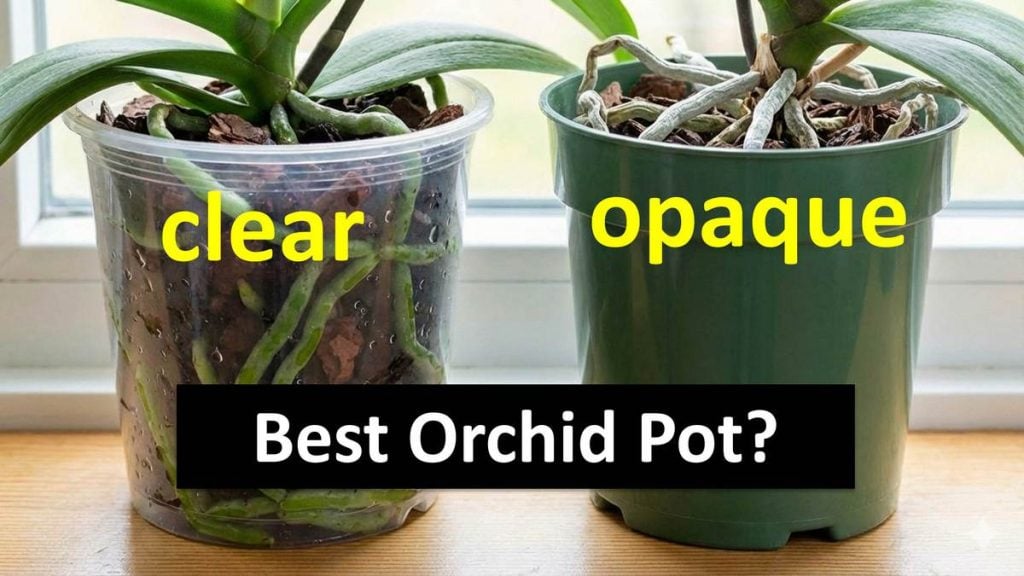
- Orchid bark and moss ultimately decompose and grow to be “bitter,” dropping the air pockets orchids want. Transparency permits you to see when the medium has compressed or damaged down, signaling it’s time to repot. Partially appropriate. Nonetheless, you shouldn’t be utilizing moss within the pot. And in the event you water appropriately and report each two years, which I extremely suggest, broken-down media is rarely an issue. The pot on the left exhibits the inexperienced roots after being watered. The one on the appropriate exhibits the dry, silvery white roots. Supply: Actuality Time
What about the advantages of chlorophyll? Many hobbyists use a “two-pot system. “The orchid is grown in a transparent plastic liner, which is then positioned inside an ornamental, opaque outer pot. When it’s time to water or examine the roots, the clear liner is lifted out. If you happen to do that, then the advantage of photosynthesis within the roots is misplaced, since not sufficient mild will get to the roots to be of any profit.

Opaque pots even have some advantages:
- They’re cheaper and available. All of mine are recycled from crops I’ve bought.
- Algae doesn’t construct up contained in the pot. A number of algae progress can preserve the roots too moist.
There are actually two new arguments for utilizing clear pots:
- Most business propagators of Phalaenopsis, the preferred orchid, are actually utilizing clear pots – they will need to have a superb purpose?
- A current examine affords precious insights into the advantages of clear pots.
The Newest Science on Clear Pots
Earlier than trying on the newest science, it’s helpful to know some primary plant chemistry. Photosynthesis is a course of the place CO2 is transformed to oxygen and sugars (carbohydrates).
Notice: The above description is what we usually inform folks, however in fact, it’s not appropriate. To be taught extra, take a look at Vegetation Don’t Produce Oxygen (O2) From Carbon Dioxide (CO2)
The sugars are utilized by the plant as an vitality supply to hold out nearly every thing that goes on in a plant. The method of utilizing the sugars to create vitality known as respiration. This course of takes the sugars, plus oxygen, and extracts the vitality, changing them to water and CO2. Respiration occurs all the time and is much like what people do.
Most plant roots can’t photosynthesize, in order that they don’t produce oxygen. As a substitute, they get the oxygen wanted for respiration from the air within the soil and from the leaves. This works fairly properly for many crops, however orchids are completely different.
Orchid roots are lined with a really thick layer of pongy materials referred to as velamen. When dry, it’s the silvery white materials you see on orchid roots.
The issue with velamen is that it’s not good at transporting oxygen into the basis. To make issues worse, the orchid leaves don’t photosynthesize very a lot and are a poor supply of oxygen for the roots. What this implies is that the roots can suffocate from an absence of oxygen, a course of generally known as hypoxia.
FREE Orchid Rising Course on YouTube:
Roots Want Oxygen
Within the wild, orchid roots carry out some photosynthesis, however a lot lower than in leaves. Nonetheless, the method does present sufficient oxygen to stop hypoxia within the roots.
A current examine from 2024 demonstrated that Phalaenopsis rising in clear pots photosynthesize sufficient to stop hypoxia, however when grown at nighttime, they don’t. The researchers instructed that roots rising in dense media, in addition to roots rising in an opaque pot, will undergo from hypoxia.
Clear pots assist orchid roots get sufficient oxygen by photosynthesis and thereby develop higher.
Roots Develop Towards Mild
Orchid roots are inclined to develop out of the pot as they attempt to attain mild. Close to the floor of the media, progress is often above the pot and up into the air. Within the media, roots will begin rising out of holes minimize into the aspect of pots.
This isn’t an enormous concern for a house gardener. You’ll be able to merely push the roots again into the media on the subsequent potting, which ought to be carried out each 2 years. Nonetheless, it’s a huge downside for business amenities. Protruding roots makes it troublesome to maneuver pots, particularly with automated equipment.

A examine from 2007 regarded on the impact of the pot on aerial root progress. After 30 days of progress, crops in opaque pots had greater than 7 roots outdoors of every container, whereas clear pots had fewer than 2 roots outdoors.
Clear pots appear to maintain roots rising contained in the pot. Irrespective of which media is used, because the plant produces extra roots, they are going to ultimately develop outdoors of the pot.
Roots rising contained in the pot may even have higher entry to water in our dry houses than roots dangling outdoors the pot.
The examine additionally examined the impact of media on root progress in opaque pots. Vegetation grown in a medium consisting of 1:1 (by quantity) chunky peat:perlite or 2:1:1 perlite:chunky peat:coconut coir had fewer aerial roots than crops grown in a bark-based or 1:1 perlite:charcoal media.
As well as, crops grown within the chunky peat:perlite combine or chunky peat: charcoal combine had the best improve in leaf span in comparison with the opposite media.
Despite the fact that chunky peat works in a managed lab state of affairs and plenty of business growers do use peat moss, I strongly suggest householders keep away from the stuff. Until watering may be very rigorously managed, it results in root rot, and is among the important causes howowners have hassle rising orchids. Use chunky coconut coir as a substitute.
If you happen to don’t consider me, possibly you’ll consider the scientists who say, “Inexperienced customers typically overwater crops offered in sphagnum, resulting in root rot and plant decline.”
Does Photosynthesis in Roots Produce Higher Vegetation?
Most sources really feel that photosynthesis in roots doesn’t add a lot carbon (sugars) to the plant. Nonetheless, by offering some native oxygen to the roots, they continue to be more healthy and extra actively rising, which contributes to the well being of the plant.
Not directly, photosynthesis within the roots helps the plant develop, and since orchids are sluggish growers anyway, a small quantity of assist can have a major impact.
What Does the Trade Use?
“A majority of Phalaenopsis growers in Taiwan and the Netherlands, and more and more, growers in america, use clear pots that enable mild to penetrate the pots.”
Root photosynthesis doubtless contributes little to complete plant photosynthesis. Nonetheless, as a result of Phalaenopsis roots keep away from darkness, the roots keep contained in the pot higher than the roots of crops grown in opaque pots.
Orchid manufacturing is now extra automated than ever earlier than.
“Growers within the Netherlands have probably the most subtle manufacturing amenities with the bottom labor inputs; it’s estimated that every plant is cumulatively dealt with lower than one minute from the time crops are faraway from flasks as tissue-cultured propagules till they’re flowering and are positioned on carts for transport to market.”
With a purpose to make it simpler for robotic units to maneuver the pots, holding the roots contained in the pots could be a big profit. That is most likely the principle purpose the business makes use of clear pots.