The best way to be a winter wildlife detective
In the present day’s put up comes from former Discovery Chief David Bree at Presqu’ile Provincial Park.
With the onset of winter, we frequently consider nature going right into a slumber, however whereas she slows down, there’s nonetheless heaps occurring outdoors.
Winter supplies a greater alternative to study what the animals of our fields and forests are as much as than do the hotter seasons.
I’m, in fact, speaking about monitoring, monitoring within the snow.
Winter’s the most effective time to sharpen your wildlife detective expertise!
Whereas the most effective trackers on the market can comply with tracks always of the yr, in all terrains, most of us want mud, sand or snow to carry tracks that we are able to simply see. And snow is the most effective as a result of it’s in all places!
Observe down some uncommon suspects
Tracks within the snow can inform you what sorts of animals are round. Many are the acquainted mammals, like squirrels and rabbits, however many tracks are of mammals that solely come out at night time or are very secretive.
And it’s not nearly identification. Monitoring lets you see what the animals have been doing.
We are able to study what routes an animal takes, when it walks and when it runs. Typically I even know what it catches to eat, all by following tracks within the snow.
What are these winter critters as much as?
Monitoring permits me to get an estimate of what number of deer are within the park, the place they prefer to go right down to the lake to drink at night time, the place they’re sleeping, and what number of younger ones are within the herd.
I can see the place small birds, juncos and sparrow most likely, have been hopping over the snow visiting all of the grass heads poking up above the floor and consuming the seeds they discover there.
You’ll be able to see the place a mouse (or vole – I can’t inform one small mammal from one other by the tracks) has come above the snow to scamper over to its subsequent tunnel…
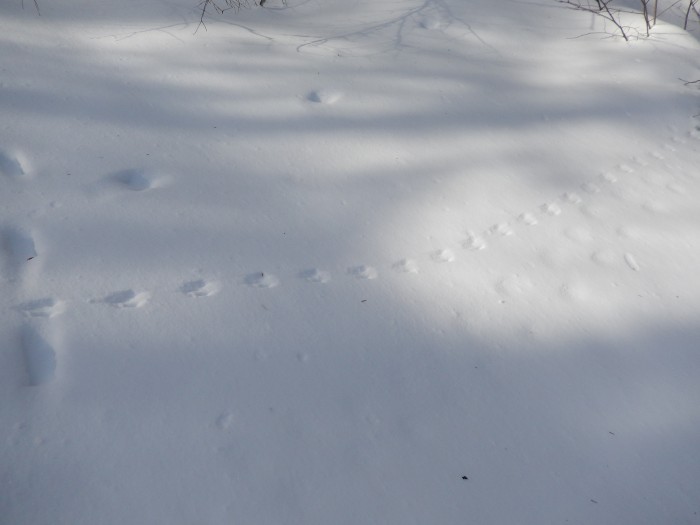
…and generally you’ll be able to see the place it didn’t make it. The tracks ending abruptly in a melancholy fringed by the marks of wing suggestions. An owl, or maybe a hawk discovered its dinner right here.
What on this planet was that?
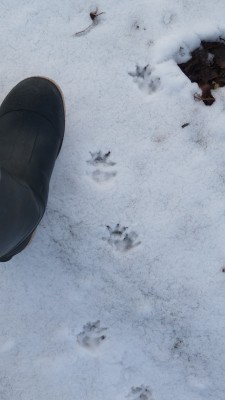
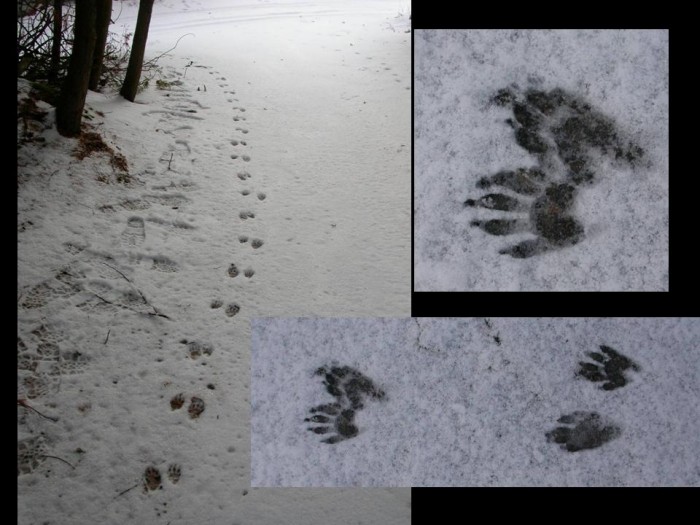
One yr, I arrived within the park’s parking zone to see the weirdest tracks I’d ever seen. Smallish with the thumb caught out at massive angle. What on this planet was that?
Fortunately there are lots of good observe books and web sites, and I discovered that my new observe was a Virginia Opossum — a mammal beforehand unknown within the park!
Right here was proof that this species was increasing its vary northward into our space, although the final two extreme winters might have knocked them again. (I’ve not seen any tracks this winter but.)
The most effective time for monitoring?
Whereas it’s fairly simple to see tracks within the snow, it nonetheless takes follow to establish the tracks you’re seeing. Begin by getting out after each gentle snowfall.
The most effective tracks are in a skinny skim of snow (5-20 mm) over a tough base. New snow on a parking zone or over beforehand arduous packed snow is right. You’ll be able to see each element and the tracks look identical to those within the books.
Okay! I’ve picked up a path! Now what?
Take a look at the fundamental form of the print and ask:
- is it spherical or elongate?
- what number of toes do you see?
- are you able to see proof of claws?
- how massive is it?
These primary questions is usually a massive assist. As an illustration, Purple Squirrel and Gray Squirrel tracks look the identical, however the gray is twice the dimensions of the crimson’s tracks.
Subsequent: search for the tracks’ patterns or gait
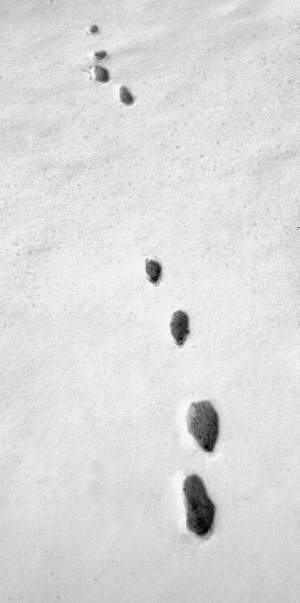
Many weasels hop, so the tracks are available pairs. Wild canine, like coyote and fox, are likely to put one foot in entrance of the opposite, so that they go away a slender, straight observe by way of the snow. Home canine stroll with their toes extra unfold out and — if off-leash — not often in a straight line.
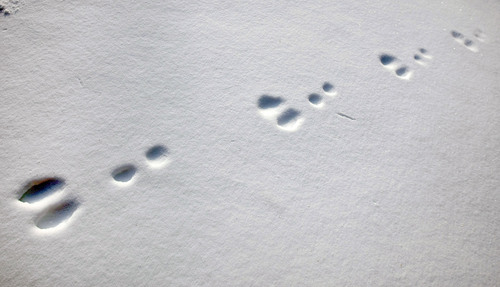
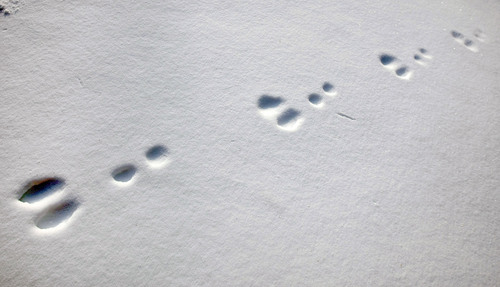
Quick-hopping rabbits and hares land with their greater hind toes in entrance, with the 2 entrance toes trailing, one behind the opposite. Squirrels are related: massive hind toes first and the 2 entrance paws touchdown behind, however they’re aspect by aspect. (It could additionally assist that the tracks finish at a tree. Squirrels climb bushes; rabbits don’t.)
Talking of bushes, don’t neglect to take a look at the bottom of tree trunks for flakes of bark. Whereas not true tracks, these indicators can point out climbing mammals or possibly foraging woodpeckers above.
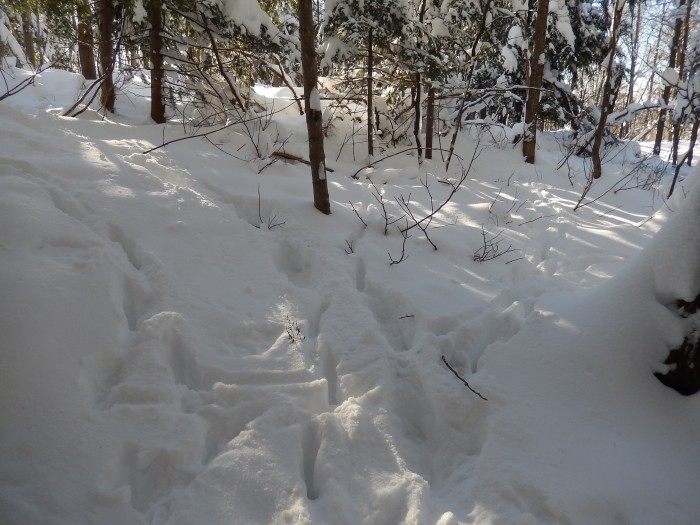
Determining tracks in deep fluffy snow is quite a bit trickier and never really useful for the newbie tracker. Prints are distorted and sometimes snow collapses on prime.
You would possibly be capable to dig down and see the hoof marks of a deer on the backside quite than the pad of a coyote however don’t be discouraged if you happen to can’t determine it out – it’s arduous!
Able to follow your individual snow sleuthing expertise?
Birds and mammals are nonetheless out and about (in search of meals or making an attempt to not be meals), and one of the simplest ways to find who’s out there’s winter monitoring.
And if you happen to see any opossum’s tracks, tell us!